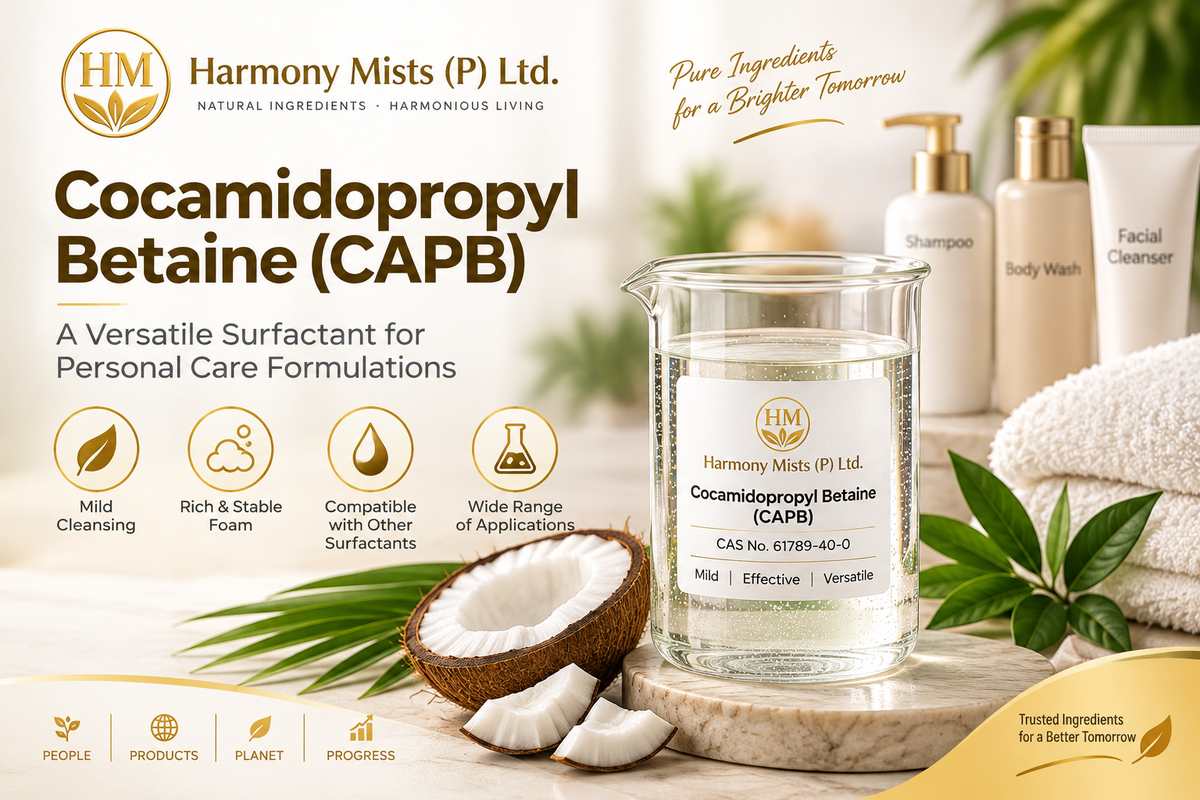
Cocamidopropyl Betaine (CAPB): Properties, Uses, Benefits and Applications in Cosmetics
Cocamidopropyl Betaine (CAPB) is one of the most widely used amphoteric surfactants in the personal care and cosmetics industry. Known for its mild cleansing properties, foam-boosting ability and compatibility with a wide range of surfactants, CAPB is commonly used in shampoos, body washes, facial cleansers, liquid soaps, hand washes and other rinse-off formulations.
For cosmetic formulators and personal care manufacturers, Cocamidopropyl Betaine offers an effective way to improve cleansing performance, foam quality and formulation characteristics while working alongside anionic, nonionic and other amphoteric surfactants.
What is Cocamidopropyl Betaine?
Cocamidopropyl Betaine, commonly abbreviated as CAPB, is an amphoteric surfactant widely used in personal care and cosmetic formulations.
Its INCI name is Cocamidopropyl Betaine and its commonly referenced CAS Number is 61789-40-0. The substance is also identified under EC No. 263-058-8.
CAPB contains both positively and negatively charged functional groups, allowing its behaviour to vary according to the pH of a formulation. This amphoteric nature makes it particularly useful for combining with other surfactants and developing mild cleansing systems.
Commercial CAPB is generally supplied as an aqueous surfactant solution with a specified active matter level. Commercial grades may therefore differ in active matter, pH, sodium chloride content, colour, viscosity and other quality specifications.
Cocamidopropyl Betaine Chemical and Product Information
Product Name: Cocamidopropyl Betaine
Common Abbreviation: CAPB
INCI Name: Cocamidopropyl Betaine
CAS Number: 61789-40-0
EC Number: 263-058-8
Surfactant Type: Amphoteric / Zwitterionic
Typical Form: Clear to slightly hazy liquid
Typical Source: Coconut-derived fatty acid feedstock
Primary Functions: Cleansing, foaming and co-surfactant
Main Applications: Shampoos, body washes, liquid soaps, facial cleansers and personal care products
Specifications can vary according to manufacturer, grade, active matter and intended application.
How Does CAPB Work?
Surfactants help reduce the surface tension between water and oils, dirt and other substances, allowing them to be dispersed and removed more easily during washing.
CAPB is particularly valuable because of its amphoteric nature. Depending on the pH of the formulation, it can exhibit different ionic characteristics.
In practical formulation terms, CAPB is frequently combined with primary surfactants such as Sodium Laureth Sulfate (SLES) and other cleansing agents.
When used in a surfactant blend, CAPB can help improve foam generation, enhance foam stability, support cleansing performance, improve sensory characteristics, contribute to formulation viscosity and improve compatibility between different surfactant types.
This makes CAPB particularly useful when formulators want to create a balanced cleansing system rather than relying on a single surfactant.
Key Benefits of Cocamidopropyl Betaine
Mild Cleansing
CAPB is widely used in mild cleansing formulations and is particularly popular in products designed for frequent use, including shampoos, facial cleansers and body washes.
Its amphoteric character makes it a useful component of formulations where mildness is an important consideration.
Excellent Foam Booster
One of the most important reasons CAPB is used in personal care products is its ability to support foam generation and foam stability.
It can produce a rich and creamy foam when combined with suitable primary surfactants, improving the consumer's perception of cleansing performance.
Compatibility with Other Surfactants
CAPB can be formulated alongside many anionic, nonionic and amphoteric surfactants.
This versatility allows formulators to develop surfactant systems with different combinations of cleansing strength, foam characteristics, viscosity and skin feel.
Supports Formulation Viscosity
CAPB can contribute to viscosity development in certain surfactant systems. Its interaction with other ingredients can help formulators achieve the desired product consistency.
The actual viscosity response depends on the complete formulation, including surfactant selection, electrolyte concentration, pH and processing conditions.
Suitable for a Wide Range of Personal Care Products
CAPB is used across numerous rinse-off applications, making it a highly versatile cosmetic raw material.
Applications of CAPB in Cosmetics and Personal Care
CAPB in Shampoo
CAPB is extensively used in shampoos as a secondary or co-surfactant.
It can help improve foam, support cleansing and contribute to the overall sensory profile of the shampoo. It is suitable for a wide range of formulations, including everyday shampoos, moisturizing shampoos and specialty cleansing products.
CAPB in Body Wash and Shower Gel
Body washes and shower gels commonly use CAPB as part of their surfactant system.
Its combination of cleansing and foaming properties makes it suitable for formulations intended to provide an effective but pleasant washing experience.
CAPB in Facial Cleansers
Facial cleansing products often require carefully balanced surfactant systems.
CAPB can be incorporated into facial cleansers to support mild cleansing and foam characteristics while allowing the formulator to combine it with other suitable surfactants.
CAPB in Liquid Hand Wash
CAPB is widely used in liquid hand wash formulations, where frequent-use characteristics, foam and cleansing performance are important.
CAPB in Liquid Soap and Cleansing Products
CAPB can also be found in a variety of liquid cleansing formulations, including hand cleansers and other rinse-off personal care products.
CAPB in Baby and Mild Cleansing Formulations
Because CAPB is commonly used in mild surfactant systems, it can be considered by formulators developing gentle cleansing products. The overall mildness of a finished product, however, depends on the complete formulation and not on CAPB alone.
CAPB and Sulfate-Based Surfactants
One of the most common formulation approaches is to combine CAPB with anionic surfactants.
For example, CAPB is frequently used alongside SLES in shampoos, body washes and liquid cleansing products.
The combination can provide a useful balance of cleansing performance, foam generation, foam stability, formulation viscosity and sensory characteristics.
The exact ratio depends on the desired product characteristics and the active matter of the individual raw materials.
CAPB Active Matter
When purchasing Cocamidopropyl Betaine, active matter is one of the most important parameters to consider.
Commercial CAPB products are commonly supplied as aqueous solutions rather than as 100 percent active surfactant. A commonly encountered commercial grade is approximately 30 percent active matter, although products with different active levels are also available.
Therefore, formulators should always distinguish between CAPB solution concentration and actual CAPB active matter.
For example, using 10 percent of a 30 percent active CAPB solution contributes approximately 3 percent active surfactant to the formulation, before considering the precise supplier specification.
This distinction is important when calculating formulations and comparing prices between different CAPB grades.
Quality Parameters to Consider When Buying CAPB
For manufacturers and formulators, purchasing decisions should not be based only on price.
Important CAPB quality parameters may include:
- Active matter
- pH
- Sodium chloride content
- Free amine or residual amine levels
- Colour and appearance
- Odour
- Specific gravity
- Viscosity
- Microbiological quality
- Heavy metal specifications, where applicable
- Residual impurities
- Packaging and storage conditions
A consistent raw material specification is especially important for large-scale manufacturing because variations in active matter, salt or other parameters can affect viscosity and finished-product performance.
Is Cocamidopropyl Betaine Safe?
CAPB has been extensively reviewed in the context of cosmetic use.
The Cosmetic Ingredient Review has evaluated Cocamidopropyl Betaine and related amidopropyl betaines. These ingredients can be considered safe for cosmetic use when appropriately formulated, including appropriate control of sensitizing impurities.
An important consideration is that CAPB-related sensitization concerns have historically been associated in part with certain impurities, including 3,3-dimethylaminopropylamine, commonly known as DMAPA, and related residual materials.
For this reason, cosmetic manufacturers should source CAPB from reliable suppliers with appropriate quality-control systems and request relevant technical specifications and Certificates of Analysis.
CAPB Storage and Handling
Cocamidopropyl Betaine should be stored according to the supplier's technical and safety documentation.
Good storage practices generally include:
- Keep containers properly closed.
- Protect the material from contamination.
- Store under recommended temperature conditions.
- Avoid unnecessary exposure to extreme temperatures.
- Use clean equipment during handling.
- Follow the manufacturer's Safety Data Sheet and Technical Data Sheet.
Storage conditions can influence the appearance, viscosity and handling characteristics of surfactant solutions.
Why Choose High-Quality CAPB?
The performance of CAPB in a finished cosmetic product depends not only on the ingredient's chemical identity but also on its quality and consistency.
A reliable CAPB supplier should be able to provide documentation such as:
- Certificate of Analysis
- Safety Data Sheet
- Technical Data Sheet
- Product specification
- Batch information
- Regulatory documentation, where required
For manufacturers exporting finished cosmetic products, consistent raw material quality is particularly important because variations in surfactant characteristics can affect production and finished-product specifications.
CAPB for Cosmetic Manufacturers and Formulators
Cocamidopropyl Betaine remains an important raw material for manufacturers of shampoos, body washes, facial cleansers, liquid hand washes and other personal care products.
Its combination of amphoteric surfactant properties, foam enhancement, cleansing support and formulation versatility makes it a practical choice for modern cosmetic formulations.
When selecting CAPB, manufacturers should evaluate the complete specification rather than simply comparing the price per kilogram. Active matter, impurity profile, consistency, documentation, packaging and supply reliability can all have a significant impact on the actual cost and performance of the ingredient.
Frequently Asked Questions About CAPB
What is CAPB?
CAPB stands for Cocamidopropyl Betaine, an amphoteric surfactant widely used in shampoos, body washes, facial cleansers, liquid soaps and other personal care products.
What is the CAS number of CAPB?
The commonly referenced CAS Number for Cocamidopropyl Betaine is 61789-40-0.
Is CAPB a natural ingredient?
CAPB is commonly described as coconut-derived because its fatty-acid feedstock is associated with coconut-derived materials. However, the finished ingredient is a chemically manufactured surfactant and should not automatically be classified as a completely natural ingredient.
Is CAPB an amphoteric surfactant?
Yes. Cocamidopropyl Betaine is classified as an amphoteric surfactant, making it compatible with a wide range of other surfactants.
Where is CAPB used?
CAPB is commonly used in shampoos, conditioners, body washes, shower gels, facial cleansers, liquid hand washes and other cleansing formulations.
What is the usual active matter of CAPB?
A widely used commercial specification is around 30 percent active matter, although different grades and concentrations are available. Always check the supplier's specification before formulation.
Does CAPB increase foam?
Yes. CAPB is commonly used as a foam booster and foam stabilizer in combination with other surfactants.
Can CAPB be used with SLES?
Yes. CAPB and SLES are frequently combined in personal care cleansing formulations to achieve a balanced surfactant system.
Is CAPB safe for cosmetic use?
CAPB has been evaluated for cosmetic use, and its safety depends on appropriate formulation and control of potentially sensitizing impurities.
Conclusion
Cocamidopropyl Betaine (CAPB) is a versatile amphoteric surfactant that plays an important role in modern cosmetic and personal care formulations. Its ability to support cleansing, foam generation, foam stability and formulation performance makes it particularly valuable in shampoos, body washes, facial cleansers and liquid hand washes.
For manufacturers, the most important consideration is not simply selecting CAPB by name, but choosing a consistent, well-specified grade with controlled impurities and reliable technical documentation.
With the right grade and formulation approach, CAPB can be an effective building block for developing high-quality cleansing products with desirable performance and consumer feel.
Looking for a reliable supplier of Cocamidopropyl Betaine (CAPB)?
Contact us to discuss your required active matter, grade, packaging and application requirements.